Meet the canary knife
Forging legacies
The production of Canarian knives is a handcrafted process that follows a tradition passed down from generation to generation.
These knives are sought after for their quality and design, with a very peculiar typology, which enjoy a well-deserved worldwide recognition. And all this thanks to the good work of the ancestors who knew how to elevate the craftsmanship to unsuspected limits in those times.
We are at a time when the current artisans of the Canarian knife have the responsibility to preserve and transmit this good practice to the new generations, to maintain and raise the bar they left us. We are bearers of a traditional craft that belongs to the people and it is our job to take care of it so that in the future people continue to speak of the Canarian knife with absolute devotion.
For this it is very importantto maintain the processes of elaboration and traditional craftsmanship, which are what define our trade and differentiate it from other types of knives from other places.
Sustainability in every cut
The material for the blades is high quality steel (mainly iron and carbon) to ensure strength, durability and proper maintenance of the cutting edge.
We work with carbon or black steels as well as stainless steels, depending on the customer’s demand and the use the knife is going to be put to.
For the ropes we mainly use goat or cow horn from the country, wood from the area and some details in bone. Our way of working and the materials we use make our workshop a respectful space with the environment and with the environment around us, we are very aware of the reuse of raw materials that help us to make the result, in addition to aesthetically striking, is sustainable.
Craft process of knives
Heated and forged by hand
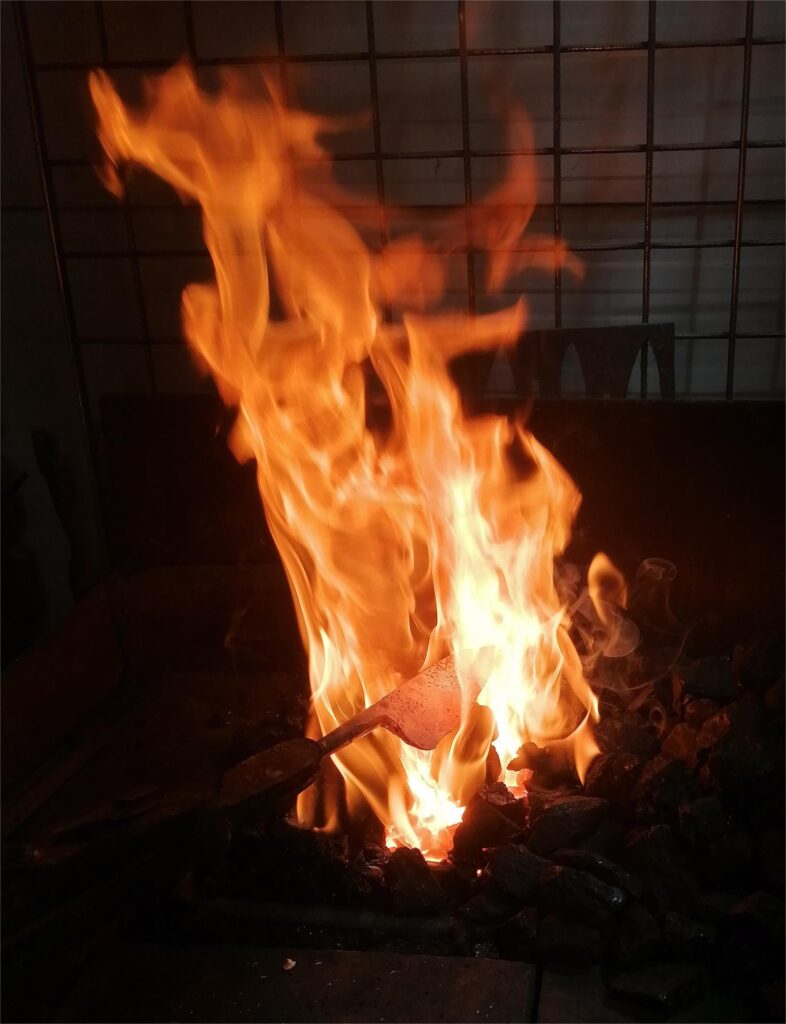
Traditionally recycled metal was forged from old tools or vehicle suspension springs, today special steels are used for cutlery. The process begins by heating the steel in a charcoal forge and raising the temperature to over 800 degrees, which allows the metal to be forged (molded) on an anvil with a hammer. We hammer the metal into its characteristic shape and remove the blade. This step requires some experience and precision to achieve the desired result.
Sheet forming and tempering
Once the forging is finished, we are going to shape the blade, that is to say to file all those roughnesses and to delimit well the forms so that the blade has its parts well defined and the finish is perfect. When we have it well formed, we return to heat to give it the temper. This consists of heating again above 800 degrees (each steel has its tempering temperature) to cool quickly and thus achieve a perfect hardness for the knife we are preparing. When we have it forged, shaped and tempered, we must do a tempering to reduce internal stresses and that our knife is still hard, but not so fragile. With this we finish the heat treatment.
Emptying and sharpening
Este proceso consiste en eliminar el acero sobrante de la hoja y darle el espesor deseado desde el Pete (lomo o contrafilo) hasta el filo. Una vez que hemos vaciado se empieza a sacar el filo. En nuestro taller todos los cuchillos se afilan a mano y con piedra de diferentes granos, para que el resultado sea un corte perfecto.
Cape assembly
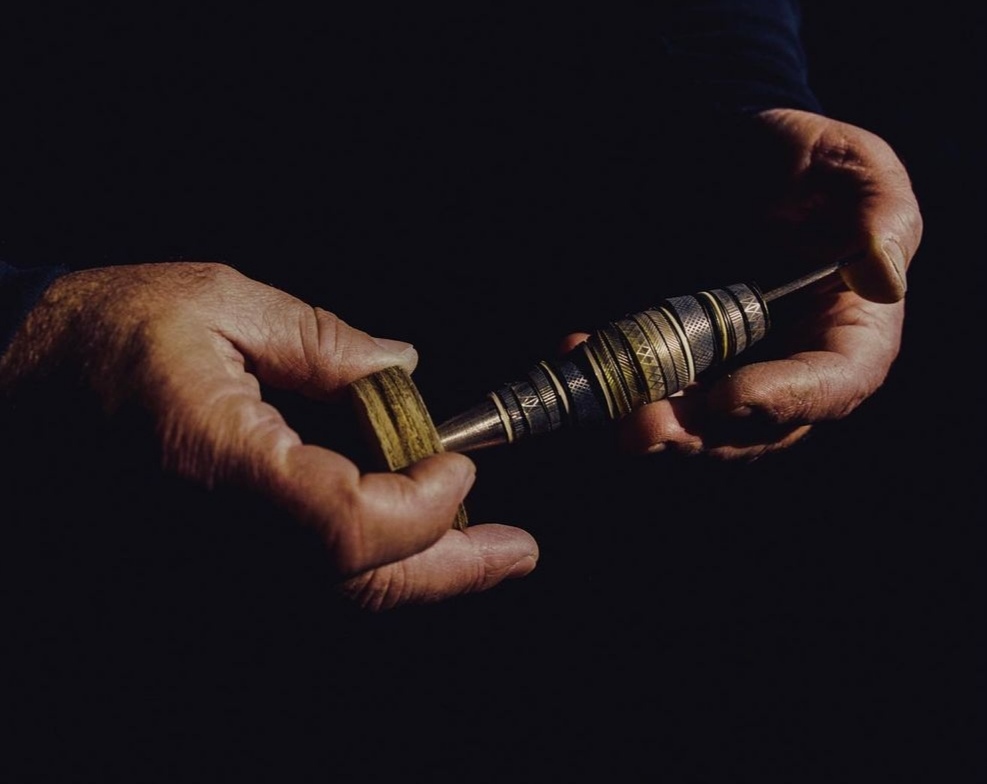
The end is a fundamental part of the Canarian knife and gives it that personality and beauty so characteristic. It is the most laborious process and the one that takes the most hours of dedication, therefore it is the one that defines the type of knife and makes the difference in both quality and price between one knife and another. Pieces of horn are cut and heated so that they can be shaped and mounted on the tang of the blade. When we have all the pieces of horn mounted on the tang and in the order they are in, the entire blade is rounded, giving it the barrel shape so well known. Then, with all the pieces rounded, we take them out again and begin to “draw” them. To do this, cuts are made with a very fine saw and in this incision a metal sheet is embedded, which will form each of the lines of the drawings that we will see in the cape.
A characteristic of the Canarian knife is that its blade can be changed because the end of the blade is pressure-fitted, without any adhesive element, and it is the end that gives the knife the great emotional value it has in the Canarian population.
Quality verification
Finally, cutting and consistency tests are performed to verify that the knife is well balanced and the cut is perfect. We check the finish of the blade and bolster to ensure that there are no imperfections. The canary knife must be functional and aesthetically attractive.
Place your order
Do you want to buy a Canarian handmade knife from Cuchillos Artesanales El Pete?
Complete the form below and we will contact you as soon as possible.

